Your phone buzzes while you’re driving. You know you shouldn’t check it, but you still wonder who messaged you. Maybe it’s important. Maybe it can wait. That tiny moment of hesitation is exactly where a routine drive can become a distracted one.
The challenge is not simply telling people to ignore their phones. Phones are designed to get our attention. That’s why technology for safe driving is increasingly focused on reducing interruptions, limiting unnecessary interaction, and giving drivers useful information without asking them to look at another screen constantly.
According to the National Highway Traffic Safety Administration, distracted driving was involved in crashes that killed 3,208 people and injured 315,167 people in the U.S. in 2024. Technology can’t take all the risk out of driving, but it can be part of a bigger strategy to keep attention where it belongs: on driving.
Key Takeaways
- Technology that promotes safe driving may remove certain distractions, but drivers still need to pay attention to the road.
- Solutions to reduce phone distraction can limit alerts and reduce the need to get busy with a device.
- Hands-free tech makes it easier to access key features without having to fiddle with your phone.
- Driver monitoring equipment can give information or warnings about some driving behaviors and attention-related concerns.
- Vehicle-connected systems can offer safety features that a phone-only solution cannot provide on its own.
- Good safety technology should support responsible driving rather than encourage drivers to interact with another screen.
- Families can combine different technologies depending on whether they need distraction control, visibility, or vehicle protection.
- The most useful technology addresses a specific driving risk while keeping the driver focused on driving.
Why Is Phone Distraction Still Such a Problem Behind the Wheel?
A phone does not have to be in your hand to become a distraction.
A notification appearing on the dashboard can make you curious. A call coming through can make you think about answering. Even a navigation instruction can lead to unnecessary interaction if the system requires you to look down or tap the screen repeatedly.
NHTSA describes distracted driving as any activity that diverts attention from driving. That includes phone use, but also adjusting navigation, changing entertainment, eating, drinking, and other activities that compete for a driver’s attention.
Phone distraction is particularly difficult because it can involve three types of distraction at once:
- Visual: your eyes leave the road.
- Manual: your hands leave the wheel.
- Cognitive: your attention shifts away from driving.
That’s why technology for safe driving should do more than make phone functions easier to access. It should also reduce the reasons to interact with them in the first place.
How Can Technology Help Prevent Phone Distractions?
The most useful phone distraction prevention tools are the ones that can work quietly in the background.
For example, drivers can use features that:
- Silence or limit notifications while driving
- Reduce incoming calls and messages
- Provide hands-free navigation
- Allow voice commands for selected tasks
- Keep frequently used information accessible without repeated phone handling
The goal is simple: technology should make driving easier without giving the driver another reason to look at a screen.
A driver who spends less time checking notifications has fewer opportunities to become distracted. But no setting can guarantee that a driver will remain focused. Drivers still need to avoid manually using their phones while driving and pull over safely when they need to handle the device.
What Types of Distracted Driving Technology Are Available?
Not all distracted driving technology works in the same way. Some solutions focus on the phone, while others are built into the vehicle.
| Technology | Primary purpose | How it can support safer driving |
| Driving modes | Reduce phone interruptions | Limits notifications and selected alerts |
| Hands-free systems | Access essential functions | Reduces the need to physically handle a phone |
| Navigation systems | Provide directions | Helps drivers follow routes without repeatedly checking a phone |
| Driver monitoring technology | Identify selected driving or attention patterns | Can provide information or alerts depending on the system |
| Vehicle safety systems | Detect certain road hazards | Can warn drivers about potential collision risks |
| Connected vehicle technology | Combine vehicle and digital information | Can provide selected alerts, location, trip or vehicle information |
These technologies are not interchangeable. A phone setting may help with notifications, while a vehicle-based system may address an entirely different safety concern.
That distinction matters when choosing technology for a family or individual driver.
How Does Driver Monitoring Technology Support Driver Awareness?
Driver monitoring technology can refer to systems that monitor particular aspects of driver behavior, attention, or vehicle performance and deliver information or warnings.
Depending on the system, monitoring may include aspects like:
- Driver attention
- Signs of distraction
- Drowsiness-related behavior
- Steering or lane position
- Vehicle speed
- Sudden braking or acceleration
Not all of them work the same way. Some lean on cameras and sensors, while others get their information from the vehicle or a connected device.
The goal is not to replace the driver. Instead, monitoring technology can provide another source of information to help catch issues a driver might not see otherwise.
That’s a critical distinction since technology should be viewed as a driver of support, not a replacement for human attention.
Where Does Technology Fit Into a Safer Driving Routine?
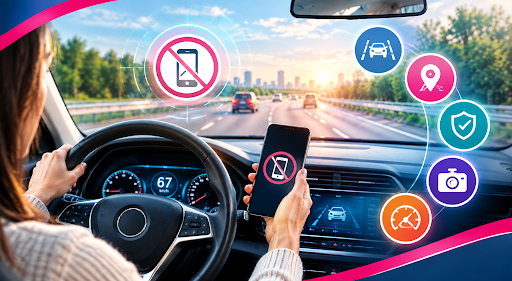
Think of safety technology as part of the journey rather than something that takes over the journey.
Before driving
Set your destination, adjust the vehicle, enable appropriate driving modes, and put your phone somewhere that reduces temptation.
During driving
Let hands-free and safety features do their intended job. Avoid interacting with screens unless you are safely parked.
After driving
If your technology provides driving information, review it when you are no longer behind the wheel. Trip information or driving insights can help families identify habits worth discussing.
This approach keeps technology in the background instead of making it another activity competing for attention.
Can Vehicle-Connected Technology Do More Than a Phone App?
Yes, in some cases. It really depends on the system.
A smartphone can provide useful safety functions, but vehicle-connected technology can interact with or monitor aspects of the vehicle that a phone alone cannot.
For example, My Drive Guardian combines vehicle-level alcohol detection and ignition protection with connected features such as safety notifications, vehicle location, driver status, and trip history.
That puts it in a different category from a simple distraction-control app. Instead of focusing only on what happens on the phone, it adds another layer around the vehicle and the people connected to it.
For families, that broader approach can be useful when their concerns go beyond phone use and include impaired driving, vehicle awareness, or staying informed about a driver’s trip.
Where Technology Can Help and Where It Has Limits
Technology can help address certain driving risks, but it cannot guarantee that a crash will not happen.
Some systems warn you when something’s wrong, and certain vehicles can even step in on their own. Phone distraction controls keep interruptions to a minimum. Driver monitoring systems keep an eye on particular behaviors and attention-related risks and let you know what they find.
But technology has limits. Drivers still need to:
- Keep their attention on the road
- Follow traffic laws
- Avoid texting or manually using a phone while driving
- Never drive under the influence of alcohol or drugs
- Adjust their driving to road and weather conditions
- Understand the limitations of their vehicle’s safety systems
The safest role for technology is to support good driving habits rather than replace them.
Bring More Safety Into Every Drive
The best technology for safe driving solves a real safety concern without adding a new distraction. For some drivers, that starts with a quiet phone and driving focus settings. For others, it means pairing hands-free features with driver awareness tools and vehicle safety technology.
My Drive Guardian takes a broader, vehicle-connected approach. It combines alcohol detection and ignition protection with connected features that give families useful visibility, not constant tracking.
Explore My Drive Guardian to see how vehicle-connected safety technology can fit into your family’s everyday driving routine.
FAQs
Frequently Asked Questions
Technology can limit notifications, support hands-free functions, and reduce the need to interact with a phone while driving. These tools can support safer habits, but drivers still need to remain attentive.
Distracted driving technology includes tools designed to reduce phone interruptions, limit certain interactions, provide hands-free functions, or alert drivers to selected safety risks.
Nope. These solutions can reduce interruptions and put some features out of easy reach, but whether a driver actually uses their phone is still up to them.
Depending on the system, driver monitoring technology may look at things like attention, whether the driver appears drowsy, how the steering wheel is being turned, where the car is in the lane, and other patterns of driving.
Yes. A regular phone app mostly depends on what your smartphone can do. At the same time, vehicle-connected technology can tap into the car's hardware, sensors, or connected systems to offer extra information and controls.