
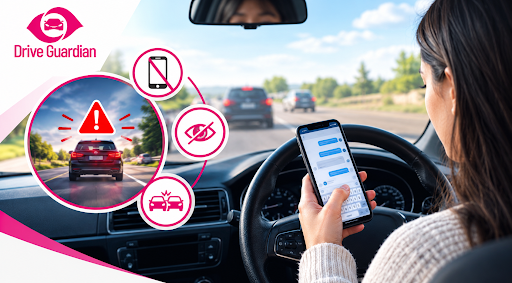
Being distracted by phone while driving can take your attention away from the road at exactly the moment you need it most.
You hear a ping, glance down, and look back up a moment later. Nothing happened, so it felt harmless. But being distracted by phone use behind the wheel is a gamble, and the road doesn’t wait for you to look back.
The tricky part is that the distraction doesn’t end when your eyes do. The tricky part is that the distraction doesn’t necessarily end when your eyes return to the road. Research from the AAA Foundation for Traffic Safety found that some voice-based tasks can leave drivers with lingering mental distraction after the interaction ends. Below, we’ll look at what phone distraction while driving really does, what the risks are, and how to build habits that work.
Key Takeaways
- Phone distraction affects your eyes, hands, and mind, and texting hits all three at once.
- A “quick” glance covers more roads than you think, because your car keeps moving the whole time.
- Your focus doesn’t snap back instantly after you put the phone down or finish a voice command.
- The real cost of distraction goes beyond crashes, reaching your wallet, your record, and your relationships.
- Prepare before you drive: set your route, silence alerts, and put your phone out of reach.
- Phone settings can reduce some distractions, but they work best alongside responsible driving habits.
- Vehicle-level safety technology adds a second layer, covering things a phone simply can’t see.
- Families follow rules they helped write, so make phone habits a conversation, not an order.
What Does Being Distracted by Your Phone Do to Your Driving?
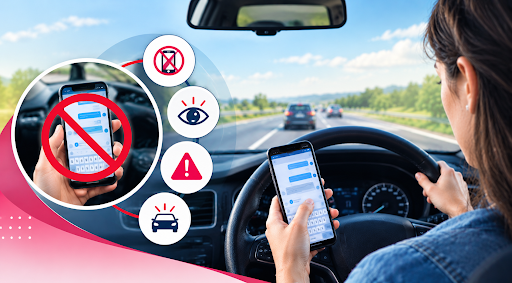
It is easy to dismiss phone distraction when a quick glance does not immediately lead to a problem. That’s what makes phone distraction while driving so easy to excuse. But even when nothing goes wrong, three things are happening behind the wheel.
Your Eyes Leave the Road
You can’t see brake lights, a pedestrian stepping off a curb, or a car easing into your lane while you’re reading a message.
Your Hands Leave the Wheel
One hand on the phone means less control the moment you need to swerve or brake hard.
Your Mind Leaves the Drive
This one surprises people. Your eyes can be on the road while your brain is still writing a reply. You’re looking, but you’re not really seeing. Texting is the worst offender because it pulls on all three at the same time.
What Counts as Phone Distraction While Driving?
Texting is one of the clearest examples, but phone distraction while driving covers much more than sending messages.
It can include:
- Reading a text or notification
- Replying to a message
- Checking social media
- Changing music or podcasts
- Looking at an email
- Entering information into an app
- Checking directions
- Making or answering a call
- Picking up the phone to see who contacted you
The common problem is not the particular app or function. It is the decision to interact with the phone while your attention should be on driving.
Even when the reason feels important, the road still requires your attention.
What Are the Real Risks of Phone Distraction While Driving?
A crash is the most serious possible outcome, but it isn’t the only risk worth considering.
| Risk | What it can look like | Who it affects |
| Crash and injury | A collision you never saw coming | You, passengers, pedestrians, cyclists |
| Close calls | Hard braking, a horn, a heart-pounding swerve | Everyone nearby |
| Tickets and fines | A citation for handheld phone use | You |
| Higher costs | Repairs, deductibles, rising insurance | You and your household |
| Lost trust | A teen or partner who won’t ride with you | Family and friends |
Add those up, and one message starts to look very expensive.
How Can You Stop Using Your Phone While Driving?
Here’s a simple plan you can start this week:
- Set up before you start. Choose your route, playlist, or podcast while you’re still parked.
- Turn on driving mode. Let your phone silence alerts for you, so you never see the buzz.
- Tell people you’re driving. An auto-reply takes the pressure off, because friends know you’ll answer later.
- Move the phone. Put it in the glove box, the center console, or the back seat- anywhere you can’t reach it.
- Pull over if it can’t wait. Find a safe spot, handle it, then go.
How Can Parents Help Young Drivers Avoid Phone Distraction?
For parents, preventing phone distraction is often about creating habits before a young driver becomes comfortable driving alone.
Instead of making the rule complicated, families can establish a simple routine:
- Set navigation before leaving.
- Put the phone away before the vehicle moves.
- Silence unnecessary notifications.
- Wait until parked to respond to messages.
- Let a passenger handle navigation when appropriate.
- Follow the same rules as the young driver.
The last point is especially important. If parents tell young drivers not to use their phones but regularly check their own phones behind the wheel, the message becomes difficult to take seriously.
A consistent example can be more effective than another warning about the dangers of texting.
Can Technology Help Reduce Phone Distraction?
Technology can support safer habits, but it should not be treated as a replacement for attentive driving. Phone settings and driving-focused tools can help reduce notifications, limit unnecessary interaction, or encourage drivers to leave the phone alone while the vehicle is moving.
Other types of safe driving technology focus on different parts of the driving experience, such as vehicle protection, alerts, location information, or driving reports.
These technologies serve different purposes.
For example, My Drive Guardian takes a connected-vehicle approach with features including in-vehicle alcohol detection, ignition protection, real-time notifications, live GPS vehicle location, driving reports, and a connected mobile application.
It is not a dedicated texting-blocking solution. Instead, it can complement phone-focused safety habits by addressing other areas of driving safety.
What Is the Best Way to Stay Focused While Driving?
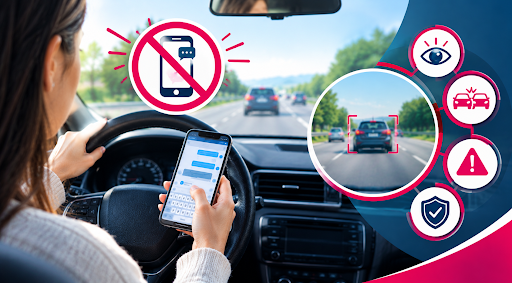
The simplest approach is to prepare before the journey and remove unnecessary phone decisions once you start driving.
Before you leave:
- Set your destination.
- Choose your music or audio.
- Check anything that genuinely needs attention.
- Activate an appropriate driving mode.
- Put your phone somewhere out of easy reach.
- Start the trip with the expectation that messages can wait.
This does not require perfect willpower. It simply creates an environment where you are less likely to reach for the phone in the first place.
Ready to Put the Phone Down and Focus on the Road?
You don’t need a complicated routine to start driving with fewer distractions. Put the phone away, give yourself time to settle into the drive, and keep your attention where it matters.
For families that want additional visibility and support, My Drive Guardian connects drivers, vehicles, and useful driving information through its mobile app and connected features.
Explore My Drive Guardian and see how connected vehicle technology can add another layer of support to your family’s everyday driving routine.
Frequently Asked Questions
Frequently Asked Questions
Being distracted by phone can take a driver’s eyes, hands, or mental attention away from the road and surrounding traffic.
The main distracted driving risks include missing changes in traffic, noticing hazards later, and having less attention available for the driving task.
A stopped vehicle is different from a moving one, but drivers should follow local laws and avoid handling a phone if they still need to remain ready to drive.
No. Hands-free technology may eliminate some physical connection with a phone, but conversations and other activities can still demand mental concentration.
Yes. Driving modes and technologies that block distractions can help reduce needless use of the phone, but are most effective when combined with appropriate driving behaviors.