
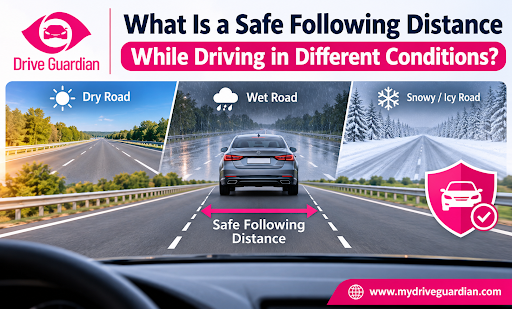
A safe following distance while driving gives you enough time to react if the vehicle ahead slows or stops. Start with at least three seconds in good conditions, then increase the gap when weather, traffic, visibility, or your physical condition makes driving more difficult.
Did you know? An NSC defensive-driving instructor guide estimates that a passenger vehicle travelling at 55 mph needs approximately 346 feet to stop, while at 70 mph the estimate rises to 490 feet. These figures assume dry pavement and specific perception, reaction, and braking times so that actual stopping distances can vary. The NSC recommends at least three seconds of following distance in good conditions, with extra time added for each additional poor condition.
Key Takeaways
- Use the safe driving tips as a starting point in good driving conditions.
- Increase your following distance in rain, fog, snow, darkness, and heavy traffic.
- Slow down when visibility or road grip is reduced.
- Avoid tailgating and sudden braking whenever possible.
- Safe following distance is an important part of road accident prevention, but it works alongside other safe driving habits.
Why Following Distance Is the Heart of Road Accident Prevention
Rear-end collisions often occur when drivers fail to leave enough space to respond to slowing or stopped traffic. Maintaining a suitable gap gives you more time to react and brake safely. Space is time, and the more space you leave, the more time you have to react.
Understanding Stopping Distance
Your stopping distance has three parts: how far you travel while you see a hazard, while you react, and while your brakes slow the car. Every part grows with speed.
| Speed | Approximate stopping distance (passenger vehicle) |
| 30 mph | About 153 feet |
| 55 mph | Nearly 346 feet |
| 70 mph | About 490 feet |
Figures from the National Safety Council. Large trucks and buses take even longer to stop.
The 3-Second Rule: A Simple Way to Check Your Following Distance

If you’re wondering what is a safe following distance while driving, the three-second rule is a practical starting point. It turns distance into time. Because you cover more ground per second at higher speeds, the gap grows automatically as you go faster, with no maths required.
It’s one of the simplest defensive driving techniques to practice, and one of the most useful driving safety rules to repeat on every trip.
How to Measure Your Following Distance Step by Step
- Pick a fixed landmark ahead, such as a road sign, an overpass, or even a crack in the road.
- Start counting the moment the vehicle in front passes it.
- Count slowly: “one thousand and one, one thousand and two, one thousand and three.”
- Check your position. If the front of your car reaches the landmark before you finish, you’re too close. Ease off the accelerator and try again.
Don’t shortcut the count. NSC driver safety consultant Ryan Pietzsch puts it bluntly: “You must say all the words.” A quick “one, two, three” is over too soon to give you a true three seconds.
Safe Following Distance in Different Conditions
Three seconds is the minimum for ideal conditions. The NSC’s “three-second-plus” approach adds time for each factor that makes driving harder.
| Situation | Suggested Following Distance |
| Good road and weather conditions, good visibility | At least 3 seconds |
| One additional poor condition | At least 4 seconds |
| Two additional poor conditions | At least 5 seconds |
| Three additional poor conditions | At least 6 seconds |
| Feeling both tired and stressed | At least 5 seconds |
These are examples based on the NSC’s three-second-plus approach, not fixed legal distances. Consider each separate risk, such as poor weather, a slippery road surface, reduced visibility or heavy traffic, and leave more space whenever needed.
Following Distance in Rain, Snow, and Fog
Wet and icy roads reduce traction, so your car needs more room to slow down. Allow at least one additional second in poor weather, and reduce your speed when road conditions require it. When visibility drops, give yourself even more space.
Following Distance at Night or When You’re Tired
You are one of the conditions. Night driving adds a second, and so does feeling ill, tired, or stressed. Pietzsch’s example: if you’re both stressed and tired, build in two extra seconds, for five in total.
Following Distance in Heavy Traffic and Behind Large Vehicles
Congestion adds time, too. Trucks and buses need more room to stop. Avoid cutting in front of them, and leave enough space for their size and braking requirements.
A real-world scenario from the NSC: imagine driving on a busy road at rush hour in the snow. Add one second for the snow, one for the road surface, and one for the congested traffic, for a total of six seconds. That feels like a lot of empty roads, and that’s exactly the point.
Defensive Driving Techniques to Protect Your Space Cushion

Effective defensive driving techniques involve more than reacting to hazards. They also include maintaining space around your vehicle and following simple habits until they become automatic:
- Check the gap often. Re-count whenever speed, weather, or traffic changes.
- Rebuild after a cut-in. If another car pulls into your gap, ease off and restore your count.
- Look past the car in front. Watching traffic further ahead gives you earlier warning.
- Stay calm. Tailgating is stressful as well as dangerous. A safe gap makes the drive easier on your nerves.
- Keep your eyes on the road. A glance at your phone eats into the buffer you just built.
Rules vary by state, so check your state’s driver handbook for local requirements on following too closely.
Build Safe Driving Habits That Last
Maintaining a safe gap, anticipating changes in traffic and keeping distractions under control all contribute to safer journeys. Consistency matters, especially when road and traffic conditions change.
For families and fleet managers, My Drive Guardian adds another layer of support through location and fleet tracking on both Android and iOS. Android users also have access to driving scores, driving behavior tracking and the AI Safety Coach.
These features can help users gain additional insight into driving habits and location information. However, following distance still depends on the driver’s judgment, awareness, and response to the road ahead.
Frequently Asked Questions
In ideal conditions, the NSC recommends at least three seconds for passenger vehicles. Add one second for each factor that makes driving harder, such as bad weather, night driving, heavy traffic, or feeling tired.
The 3-second rule is a way to check your following distance. When the car ahead passes a fixed landmark, count three full seconds. If you reach the same spot before you finish, you’re following too closely.
At 60 mph, you travel about 88 feet every second. A three-second following gap is therefore approximately 264 feet in good conditions. Increase that gap in rain, at night or in heavy traffic, and reduce your speed when conditions require it.
Use at least three seconds as your starting point in good conditions. Under the NSC's three-second-plus approach, add at least one second for each additional poor condition, such as wet roads, heavy traffic, or fatigue. Slow down and leave more room if conditions are particularly difficult.
Yes. Large trucks and buses take longer to stop than passenger vehicles. Give them extra room, and don’t cut in front of them.